

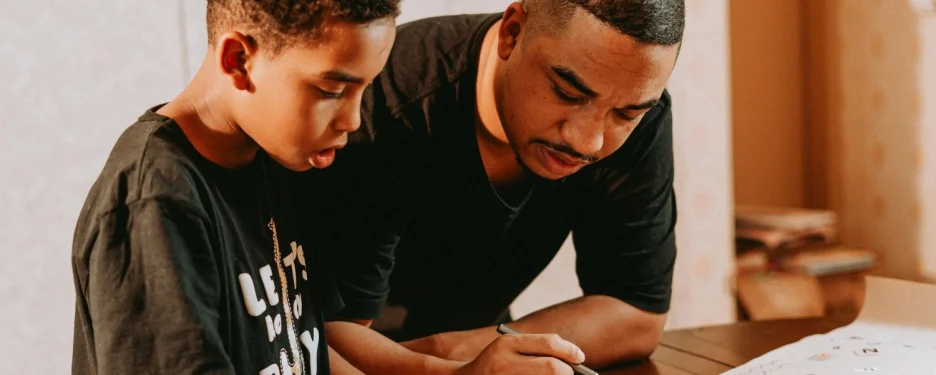
The Role of the Father: How Fathers Ignite in Their Children the Desire to Grow
There is a moment -- and most of us can find it somewhere in memory if we look hard enough -- when a father did something that made us want to be more. Maybe he showed us how to fix something broken. Maybe he spoke about his own life with unusual honesty. Maybe he simply looked at us and we felt, for a flicker, that who we were becoming actually mattered to him. That flicker. That is what we are talking about here.
The role of the father in a child's life is not well understood. We talk about it in terms of presence and absence, of breadwinning and discipline, of school runs and weekend football. But beneath all of that -- beneath the logistics of modern fatherhood -- is something older and more consequential. Something that shapes not just behaviour, but the very hunger a child feels to grow up and become someone.
More Than a Provider: The Father's Psychological Role
Let's be honest about what culture has done with fatherhood. For decades, the story we told was simple: the father earns. The mother nurtures. Children grow. And yes, economic provision matters -- nobody is romanticising poverty here. But the reduction of fatherhood to a financial function has cost us something.
In Jungian psychology, the father archetype carries a cluster of qualities that go far beyond income: action, consciousness, independence, the capacity to move outward into the world. As explored in Jacquet's (2025) doctoral research at the University of Essex, The Devouring Kronos, Jung positioned the father as a figure symbolising those very masculine principles -- and crucially, as the one who breaks the child's symbiotic relationship with the mother and initiates entry into the wider world. The father, in this view, is not just a person. He is a force of orientation.
And in mythology, the father archetype appears everywhere -- as king, protector, lawmaker, sage. Drawing on Hopcke (1989), Jacquet (2025) describes the 'Father Archetype' as the idea or image of a father that exists in society's collective unconscious. This is not abstract theory. It lives in how children experience authority, safety, and the sense that there is a world worth entering.
The father's influence on children does not operate at the level of explicit instruction. It operates through atmosphere. Through what he models, tolerates, and celebrates. Through the quality of his attention.
The Desire to Grow: How Fathers Spark Ambition and Becoming
There is a phrase in Jacquet's (2025) thesis that stopped me when I first read it. Speaking about what fathers do at their best, he writes:
"One of the most crucial things a father can do is to inspire his son's ambition to grow up by demonstrating to him how to fulfil his desires." (Jacquet, 2025, p. 127)
Demonstrating. Not lecturing. Not demanding. Demonstrating.
This is the heart of fatherhood psychology as I understand it from both the literature and from years of working with men. Children do not grow because they are told to. They grow because they see someone ahead of them who makes growth look alive, worth doing, even worth suffering for. A father who is genuinely engaged in his own becoming -- who has passions, struggles with purpose, takes risks -- gives his child a living template. A reason to want more.
And the 'good father', as Jacquet (2025) describes drawing on the clinical literature, is specific about how he supports that inner life: 'The father who acknowledges his child's differences is the same person who gradually teaches his child to control his emotions; the one who helps his child's inner life by assisting him in developing his own beliefs, thoughts, and desires in life.' He is not producing a mirror of himself. He is helping something genuinely new emerge.
This connects directly to autonomy. Jacquet (2025), citing Greenacre (1966), highlights the father's role in facilitating the child's independence -- not by pushing prematurely, but by being present and differentiated enough that the child has something to push off against. A wall, not a fog. A real person, not a performance of fatherhood.
Explore more on men's psychology at MenInnerSearch: www.meaninnersearch.com
The dynamic here also involves the Senex and Puer archetypes -- the old man and the young man. The good father carries the grounding Senex energy that orients the Puer's wild longing to become. Without that containment, the son's ambition floats. It has no earth. But with it -- with a father who holds both structure and freedom -- the desire to grow can root itself and become something real.
When the Father is Absent -- or Devouring
The absence of adequate fathering leaves marks. Jacquet (2025) draws on Osherson (1986) to show how a boy growing up without a father figure develops a weaker sense of masculine identity, less emotional security and confidence. The template is simply missing. He constructs it from fragments -- peers, media, whatever strong man crosses his path.
Biller (1982), also cited in Jacquet (2025), is more direct: without a father, boys show lower self-esteem and confidence, struggle to develop their sense of manhood, and tend toward less industriousness. These are not soft outcomes. They show up in relationships, in ambition, in the relationship with work and meaning.
And then there is the opposite failure: not absence, but devouring. Jacquet's (2025) thesis takes its name from Kronos -- the Titan who swallowed his children whole rather than allow them to grow and surpass him. The devouring father is not necessarily absent. He may be very present. But his presence is about control rather than initiation. He needs his child small. Dependent. Not becoming.
Too much Kronos -- as Jacquet (2025) frames it -- crushes the son's desire to become. The boy learns that growth is dangerous, that ambition is threatening, that growing up means losing the father's love. This is father and child development at its most bruising. The wounds from this kind of fathering are often the quietest and the deepest.
Pirani (1988), referenced through Jacquet (2025), points to something often overlooked: absent or inadequate fathering has a negative impact on a child's creativity. The imagination shrinks. And Corneau's (2003) work, also drawn upon by Jacquet, maps the long-term effects with uncomfortable precision. Harris (1996) goes further -- suggesting that the 'search for the father' is an archetypal issue affecting every generation, not just the sons of literally absent men.
The Father Who Shows Up: What Research Says
The clinical and archetypal picture is substantiated by the empirical literature. Research by Yogman and Eppel (2021, doi.org/10.1007/978-3-030-75645-1_2) found that fathers' involvement substantially influences children's and families' health and development across all phases of life -- prenatal through adolescence. The father's influence on children is not a blip. It is a through-line.
Connor and Stolz (2021, doi.org/10.1177/0192513X21994628) found that fathers' self-perceived knowledge of their child's needs positively predicted engagement. Fathers who believe they matter tend to show up more. A father who has been told -- explicitly or implicitly -- that he is the assistant parent will act accordingly. Restoring that sense of competence and purpose is not sentimental. It has measurable outcomes.
And the Opondo et al. (2016) ALSPAC cohort study (doi.org/10.1136/bmjopen-2016-012034) -- tracking over 9,000 children -- found that fathers with high emotional responsiveness scores had children with 14% lower odds of behavioural problems at age nine. Not time logged. Not activities completed. The quality of the father's attunement. That is what moved the needle.
This is what fatherhood psychology has been pointing toward for decades now: the role of the father is not a backup function. It is primary, shaping, formative in ways we are only beginning to fully articulate.
The Flame a Father Keeps Lit
There is something a father carries that no one else quite carries. Call it the flame of the possible. The unspoken promise that there is a world outside the family home worth entering, worth fighting for, worth becoming worthy of.
Children sense that flame. They watch for it. When a father burns with genuine investment in life -- in his work, his values, his own growth, his willingness to face hard things -- the child sees it. And something is kindled in them in return. Not transmitted. Kindled. It comes from the child, but it needed a spark.
The role of the father in this is irreplaceable. Not because mothers do not offer their own essential fire. But because the father's flame is oriented differently -- outward, forward, into the world. It is the flame that says: there is somewhere to go, and you are capable of getting there.
That is the gift. And it is always, quietly, available to give.
Sources